


Why Structured Learning is the Key to Becoming an Effective HRBP

What Does It Mean to Be an HRBP?
The HRBP role, as defined by Dave Ulrich, goes far beyond administration. An HR Business Partner
operates at the crossroads of people and business strategy. They are:
1. Strategic Partners, aligning talent with business goals.
2. Change Agents, helping organizations adapt and transform.
3. Employee Champions, ensuring people feel engaged and valued.
4. Administrative Experts, ensuring HR systems run smoothly.
In short, an HRBP is not just an HR professional — they’re a business leader with HR expertise.

Why the Role is Challenging
For someone like Riya, who didn’t have an MBA or formal exposure to business strategy, the HRBP role
felt overwhelming. She had people skills, but lacked:
1. Business Acumen – How the company actually drives growth.
2. Analytics Skills – Using workforce data to make decisions.
3. Change Management Tools – Navigating restructures or mergers.
4. Legal & Compliance Know-how – Understanding laws and policies deeply.
5. Confidence to sit at the leadership table and be heard.
This is where many early-career HR professionals struggle. They are good at operations, but the
“business partner” side of HR requires a different toolkit.
Why Structured Learning Matters
Without structured learning, professionals often learn on the job through trial and error. But in high-
stakes HRBP conversations, mistakes are costly. A structured program ensures:
1. A balanced foundation across strategy, operations, and people skills.
2. Exposure to real-world scenarios before facing them at work.
3. The ability to speak the language of business leaders, not just HR jargon.
4. The confidence to move from being a support function to a true partner.
How GME Academy Prepares Future HRBPs
Recognizing this gap, GME Academy designed the Practical HR Business Partner Program — a unique
12-weekend course tailored for graduates, psychology students, and non-MBAs who want to transition
into impactful HR roles.
What participants gain:
1. Structured, Practical Learning – Focused on what HRBPs actually do in companies.
2. Weekend Sessions – Just 1 hour on Saturdays and Sundays, easy to balance with work or study.
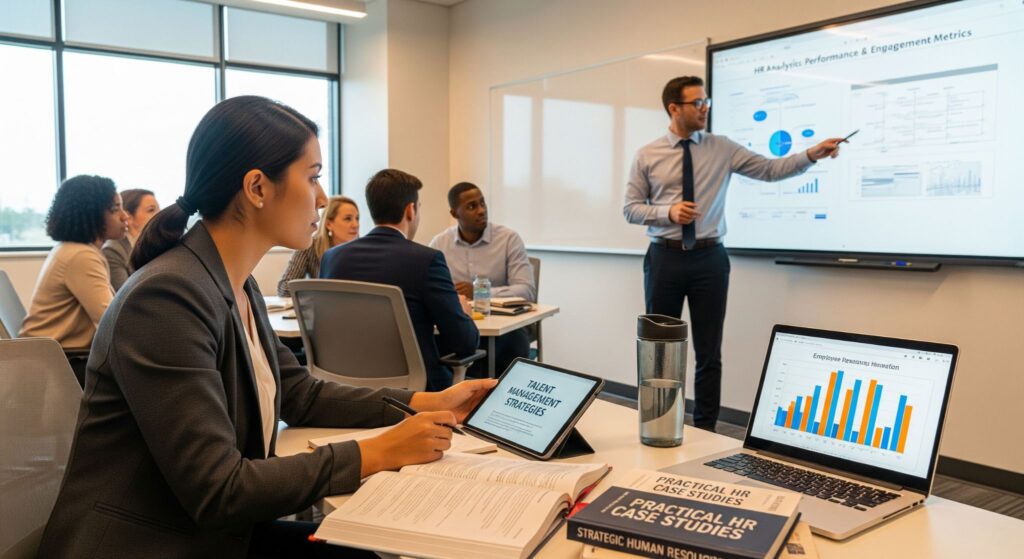
3. Core Modules – Talent management, employee engagement, HR analytics, business alignment,
and legal basics.
4. Case Studies & Simulations – Practice conversations HRBPs face daily.
5. Mentorship by Experts – Learning directly from seasoned HR practitioners.
By the end of the program, participants don’t just understand the HRBP framework — they are ready to
step into roles like Riya’s with confidence and competence.
Closing Thought
And that’s exactly what GME Academy is here to help you achieve.
0 responses on "Evolve from HR Generalist to HR Strategic Partner"