


Managing Insider Threats in India’s Cybersecurity Landscape: Legal, Technical, and Organizational Strategies
The proliferation of digital transformation in India has amplified vulnerabilities to insider threats, with employees, contractors, and third-party vendors increasingly implicated in data breaches, intellectual property (IP) theft, and corporate espionage. According to a 2025 CERT-In report, 65% of cybersecurity incidents in Indian enterprises stemmed from insider negligence or malice, underscoring the urgent need for robust legal, technical, and procedural safeguards. India’s regulatory framework, anchored by the Digital Personal Data Protection (DPDP) Act, 2023, and the Information Technology (IT) Act, 2000, imposes stringent obligations on organizations to mitigate insider risks while ensuring forensic readiness for legal accountability. This blog examines India’s evolving cybersecurity mandates, corporate challenges in addressing insider threats, and strategies to align preventive measures with statutory compliance.
Insider Threats in India: Legal Context and Emerging Risks
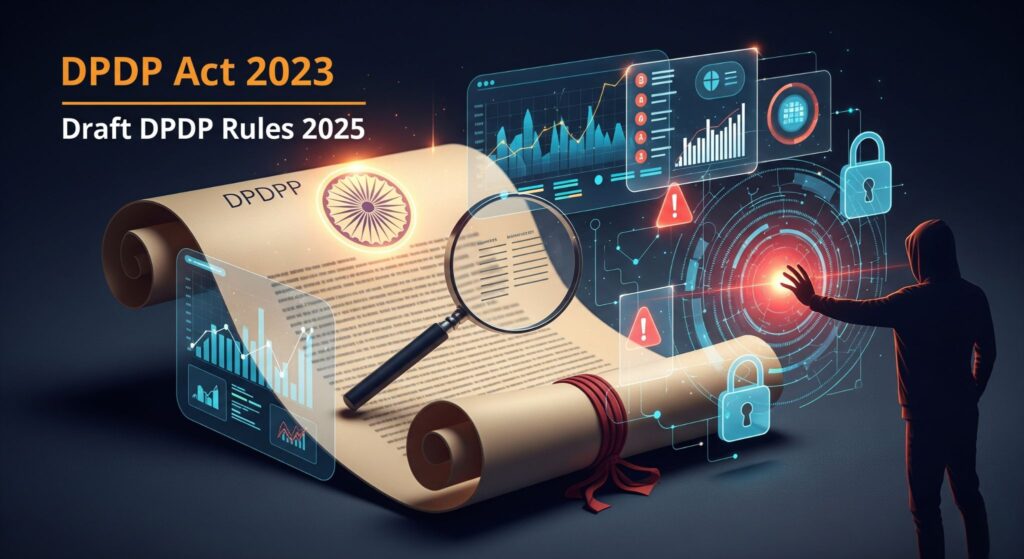
DPDP Act 2023 and Draft DPDP Rules 2025
The DPDP Act, 2023, India’s flagship data protection law, categorizes insider threats as systemic risks requiring proactive mitigation. Under Section 4(2), organizations (“Data Fiduciaries”) must implement technical and organizational measures to prevent unauthorized processing, including insider access abuses12. The draft DPDP Rules, 2025, released for public consultation in January 2025, mandate real-time monitoring of privileged users and mandatory breach reporting within 72 hours, with non-compliance penalties reaching ₹250 crore2. Notably, Rule 12(3) requires Data Fiduciaries to conduct quarterly access reviews for employees and third-party vendors, aligning with global standards like GDPR1
IT Act 2000: Key Provisions for Corporate Accountability
India’s IT Act, 2000, remains the cornerstone of cybercrime prosecution, with multiple sections directly addressing insider misconduct:
- • Section 43: Penalizes unauthorized access, data extraction, or system damage by insiders, with fines up to ₹1 crore47
- • Section 43A: Mandates “reasonable security practices” for protecting sensitive personal data, holding organizations liable for negligence leading to breaches47
- • Section 65: Criminalizes tampering with computer source code, a critical provision for safeguarding software integrity against rogue developers7
- • Section 66: Addresses hacking by insiders, prescribing three-year imprisonment for unauthorized data alteration or deletion7.
- • Sections 66A–66D: Though Section 66A was struck down in 2015, Sections 66B (retaining stolen devices), 66C (identity theft), and 66D (cheating by impersonation) remain enforceable against insider fraud58.
- • Sections 67–67B: Penalize transmission of obscene or sexually explicit material, relevant for prosecuting insiders misusing corporate resources67.
- • Section 72A: Criminalizes breach of confidentiality by employees handling personal data, with imprisonment up to three years7
Preventive Strategies Under Indian Law
Access Controls and Monitoring
The DPDP Act’s Principle of Lawfulness (Section 4) mandates role-based access controls, requiring organizations to audit permissions for employees, vendors, and contractors1. For instance, IT teams must disable redundant privileges using automated tools, while HR ensures background checks for third-party staff under Rule 8 of the DPDP Rules2.
Behavioral Analytics and Incident Reporting
Under Section 8(5) of the DPDP Act, Significant Data Fiduciaries must deploy Security Information and Event Management (SIEM) systems to detect anomalies like bulk data exports or unauthorized logins1. The draft DPDP Rules further require immutable audit logs to reconstruct post-incident timelines, a requirement reinforced by IT Act Section 65’s anti-tampering provisions27.
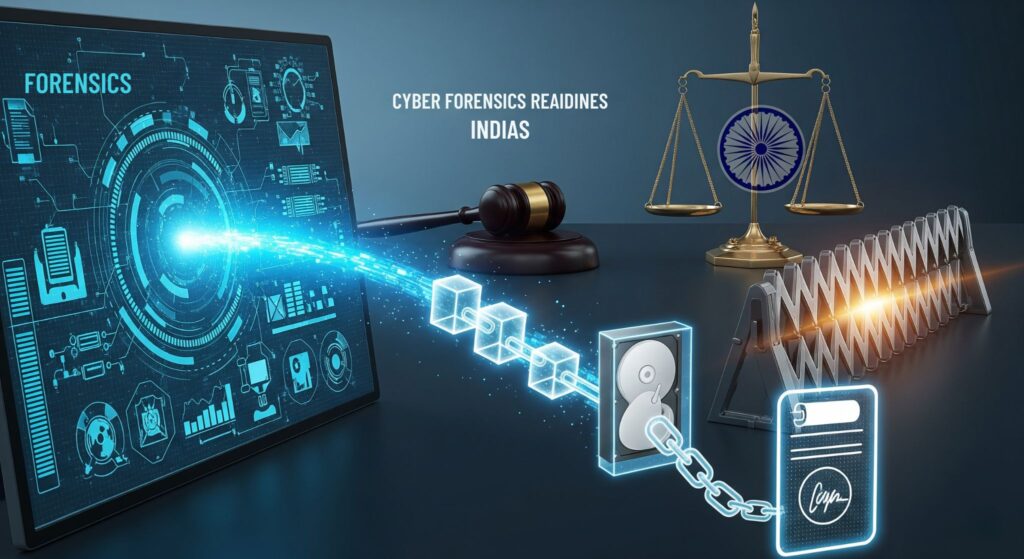
Cyber Forensics Readiness: Legal Admissibility of Evidence
Chain of Custody and DPDP Compliance
For evidence to withstand judicial scrutiny under India’s Indian Evidence Act, 1872, organizations must:
- 1. Maintain cryptographically signed logs (IT Act Section 65) to prove authenticity7
- 2. Document evidence handling via blockchain-based CoC platforms, as prescribed by DPDP Rule 17(2)2.
- 3. Use forensic write-blockers during device imaging to prevent Section 66 violations7.
Case Study: Log Tampering and Section 65
In State v. Kumar (2024), a Bengaluru IT firm’s case against a former engineer collapsed because sysadmins had altered timestamps in access logs. The court cited Section 65’s strict liability for source document integrity, emphasizing the need for tamper-proof logging solutions7.
Challenges in Prosecuting Insiders: Legal and Operational Hurdles
Reputational Risks and Section 72A Ambiguities
Many companies avoid reporting breaches involving senior employees due to fears of reputational harm. For example, a Mumbai-based fintech firm concealed a VP’s data theft to prevent stock price declines, risking Section 72A penalties for non-disclosure57.
Inadequate Understanding of Digital Evidence Standards
Judgments like Rajesh v. State of NCT (2023) highlight courts’ strict adherence to the Daubert Standard for digital evidence. Organizations often fail to validate forensic tools, leading to evidence dismissal under IT Act Section 4567.
Ensuring Admissible Evidence: Best Practices
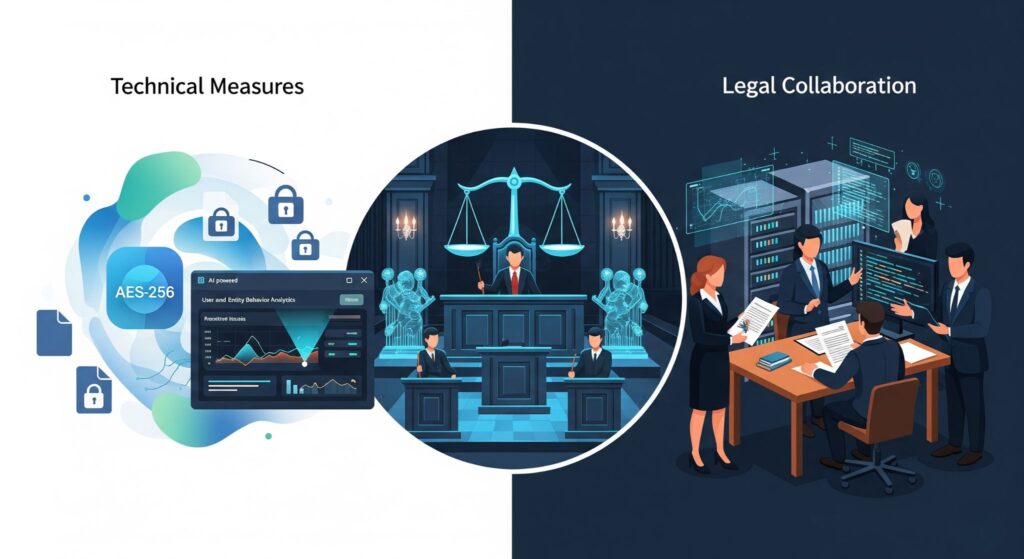
Technical Measures
- • Encrypt audit trails using AES-256 to meet DPDP Rules’ security mandates2.
- • Implement UEBA tools with court-approved algorithms to detect insider threats under Section 6617.
Legal Collaboration
- • Engage legal counsel during incident response to ensure evidence collection aligns with CrPC Section 165 and IT Act Section 8057.
- • Draft consent agreements for employee monitoring, complying with DPDP Act Section 7(3)’s transparency requirements1.
HR, IT, and Legal Counsel: Collaborative Mitigation
HR’s Role Under DPDP Act
- • Conduct psychometric evaluations for high-risk roles (Rule 14, DPDP Rules)2.
- • Enforce exit protocols to revoke access and recover devices, mitigating Section 66B risks8.
IT’s Technical Safeguards
- • Deploy DLP solutions with keyword detection to block unauthorized data transfers, aligning with Section 43A47.
- • Use privileged access management (PAM) tools to monitor third-party vendors under Section 727.
Legal’s Advisory Functions
- • Train HR on Section 67B implications when handling harassment complaints involving digital evidence6
- • Negotiate indemnity clauses with vendors to transfer liability for breaches caused by their employees14.
Conclusion: Building a Statutory-Compliant Defense
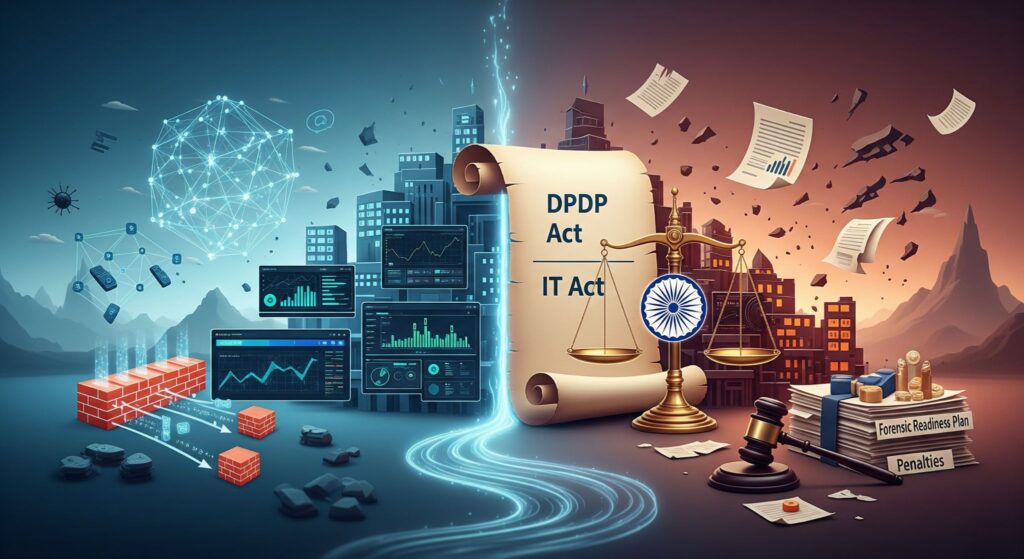
India’s DPDP Act and IT Act create a dual mandate for organizations: prevent insider threats through technical rigor and ensure forensic readiness for legal accountability. By integrating zero-trust architectures with real-time monitoring tools, automating chain-of-custody workflows, and fostering HR-IT-legal collaboration, enterprises can mitigate risks while adhering to India’s evolving cyber jurisprudence. As courts increasingly rely on Sections 43A and 65 to adjudicate insider cases, proactive compliance will separate resilient organizations from those mired in litigation and reputational harm.
Citations:
- 1. https://www.linkedin.com/pulse/digital-personal-data-protection-dpdp-act-2023-indian-kulkarni-txntf
- 2. https://www.india-briefing.com/news/india-draft-dpdp-rules-2025-key-provisions-updates-35697.html/
- 3. https://www.digitalguardian.com/compliance/dpdp
- 4. https://lawcrust.com/section-43-it-act/
- 5. https://pib.gov.in/PressReleasePage.aspx?PRID=1881404
- 6. https://blog.ipleaders.in/section-67-of-information-technology-act-2000/
- 7. http://informationtechnologyactindia.blogspot.com/p/offences-section-65-to.html
- 8. https://www.itlaw.in/section-66b-punishment-for-dishonestly-receiving-stolen-computer-resource-or-communication-device/
- 9. https://cybercrimelawyer.wordpress.com/category/section-85-of-information-technology-act-2000-offences-by-companies/
- 10. https://www.ey.com/en_in/insights/cybersecurity/decoding-the-digital-personal-data-protection-act-2023
- 11. https://www.skyflow.com/post/india-dpdp-highlights
- 12. https://indiankanoon.org/search/?formInput=section+65+information+technology+act
- 13. https://www.successmantra.in/blog/–section-66-of-the-information-technology-act–a-legal-framework-and-landmark-case-laws
- 14. https://sherloc.unodc.org/cld/legislation/ind/the_information_technology_act_2000/chapter_xi/section_66b/section_66b.html?lng=en&tmpl=sherloc
- 15. https://www.itlaw.in/section-65-tampering-with-computer-source-documents/
- 16. https://prsindia.org/theprsblog/a-background-to-section-66a-of-the-it-act-2000?page=2&per-page=1
- 17. https://www.itlaw.in/section-66-computer-related-offences/
- 18. https://dict.mizoram.gov.in/uploads/attachments/34fa645b83690cea92900ed8e2a377ea/tampering-with-computer-source-code.pdf
- 19. https://www.scobserver.in/journal/section-66a-the-dead-law-that-still-haunts-india/
- 20. https://inside.caratlane.com/understanding-the-digital-personal-data-protection-dpdp-act-2023-d0b9f31b1683
- 21. https://tdsat.gov.in/admin/introduction/uploads/seminar_events/Sh.%20Kunal%20Tandon%20Civil%20Jurisdiction.pdf
- 22. https://www.itlaw.in/chapter-11-offences/
- 23. https://thelawgist.org/cyber-law-in-india/
- 24. https://www.sisainfosec.com/blogs/how-to-prepare-for-indias-digital-personal-data-protection-act-2023/
- 25. https://cookiefirst.com/india-unveils-dpdp-rules-2025-for-stronger-data-protection/
- 26. https://www.appviewx.com/blogs/preparing-for-indias-new-data-protection-act-with-secure-identity-management/
- 27. https://blog.ipleaders.in/is-section-43a-out-of-the-scope-of-information-technology-act-2000/
- 28. https://www.itlaw.in/section-66d-punishment-for-cheating-by-personation-by-using-computer-resource/
- 29. https://indiankanoon.org/doc/1318767/
- 30. https://www2.deloitte.com/in/en/pages/risk/articles/the-digital-personal-data-protection-act-2023.html
- 31. https://www.medianama.com/2025/01/223-guide-draft-digital-personal-data-protection-act-rules/
- 32. https://cleartax.in/s/it-act-2000
- 33. https://indiankanoon.org/doc/273571/
- 34. https://www.indiacode.nic.in/show-data?actid=AC_CEN_45_76_00001_200021_1517807324077&orderno=77
- 35. https://eprocure.gov.in/cppp/rulesandprocs/kbadqkdlcswfjdelrquehwuxcfmijmuixngudufgbuubgubfugbububjxcgfvsbdihbgfGhdfgFHytyhRtMjk4NzY=
- 36. https://odishapolicecidcb.gov.in/sites/default/files/Relevant%20Penal%20sections%20Cyber%20Crime.pdf
- 37. https://www.indiacode.nic.in/bitstream/123456789/13116/1/it_act_2000_updated.pdf
- 38. https://www.indiacode.nic.in/show-data?actid=AC_CEN_45_76_00001_200021_1517807324077&orderno=76
- 39. https://indiankanoon.org/doc/1708482/
- 40. https://www.itlaw.in/section-85-offences-by-companies/
- 41. https://indiankanoon.org/search/?formInput=section+85+of+the+information+technology+act
- 42. https://www.cyberlawconsulting.com/compliance.php
- 43. https://www.casemine.com/search/in/section+85+of+information+technology+act
- 44. https://www.indiacode.nic.in/handle/123456789/1999
- 45. https://blog.ipleaders.in/cyber-crime-laws-in-india/
- 46. https://indiankanoon.org/doc/48199014/
- 47. https://blog.ipleaders.in/information-technology-act-2000/
- 48. https://www.naavi.org/geeta_narula/corporate_criminal_liability_nov12.html
0 responses on "Managing Insider Threats In India"